|
The instructions in this article relate to Report Set. The icon may be located on your StrataMax Desktop or found using the StrataMax Search. |
Report Sets have been designed for running a specific set of reports quickly for meetings, financial year ends, audits, tax, and legislative requirements such as NSW Section 55 reporting, for multiple buildings, for either the current or the previous year, where set.
When to use Report Set
Report Set is used when multiple reports need to be grouped and produced together for a building or purpose.
Search screens, Report Distribution, Report Set, and Stored Reports are used for different purposes:
- Report Set: Use this when multiple reports need to be grouped and produced together for a building or purpose.
- Search screen: Use this when you need to locate records, add columns, filter results, or export a list of data to Excel.
- Report Distribution: Use this when you need a configured report, notice, letter, label, certificate, ledger card, report pack with functionality to store.
- Stored Reports: Use this when you need to retrieve, resend, reprint, or review reports that have already been generated and saved.
Note: Some older Global Reports and Preview Feature outputs are now accessed through Search screens or Report Distribution. If a legacy menu no longer gives the expected output, search for the report name and review the relevant Search or Report Distribution article.
Create New Report Set
To use the report set feature, ensure that Report Distribution is available in Advanced mode.
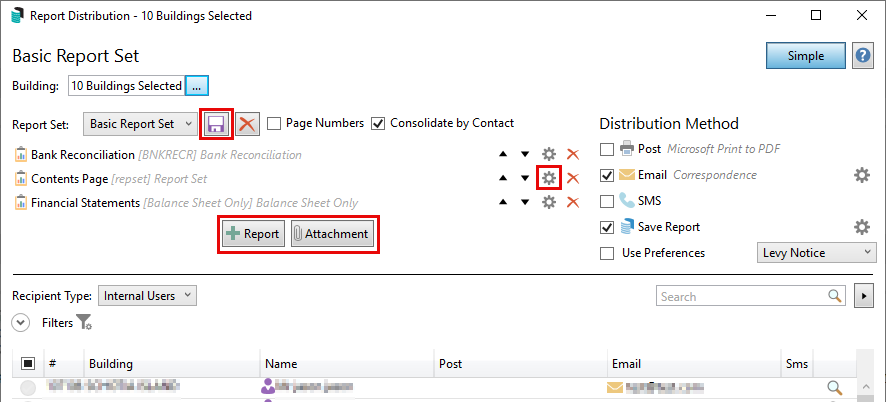
- Search or select Report Set.
- From the Report Selection window, search for or select the required report or merge letter.
- Tip: Start with the contents page as the first report. This avoids having to move that report in the list after each addition.
- Select the + Report button to add the next report. Repeat for each required report.
- Select the cogwheel icon for each report to set individual report options, such as Financial Year.
- Select Attachment to add an attachment from DocMax or a folder location. Repeat for any other attachments that are required.
- Select the Save icon and enter a report set name (30-character limit).
Distribute Report Set
- Search or select Report Set.
- Open the Report Set selection and choose the required set from the list.
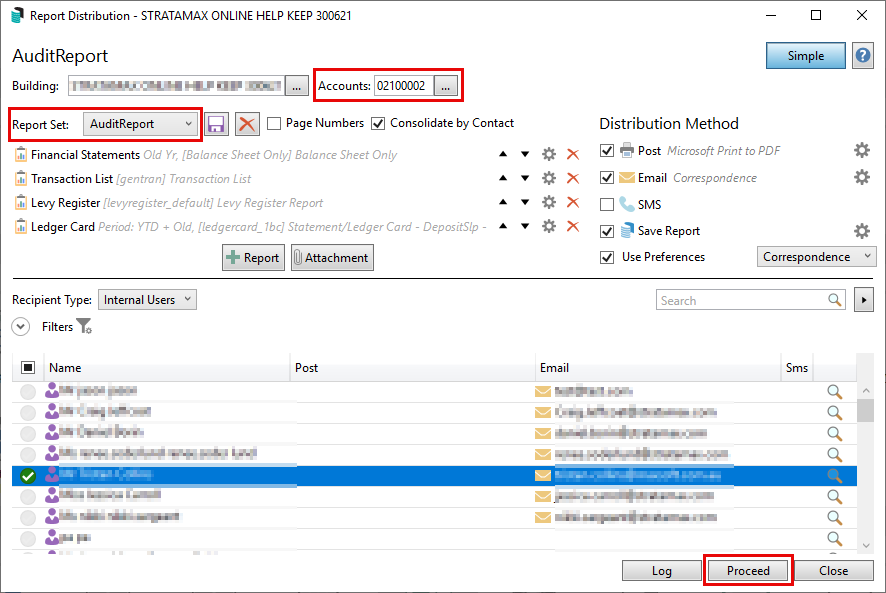
- Where the reports include lot-specific account reports, select the Accounts area and tag the required account or accounts.
- Use the building selector tool for multiple buildings. The filters can be expanded for specific scenarios, for example, Financial End Month for year-end buildings, or Account Manager for a specific subset of buildings.
- Review the Distribution Method. If the report set is to be saved to DocMax, ensure that a profile is selected in the settings.
- Select Proceed to preview the report set.
- From the preview window, select Proceed to distribute the report set using the selected distribution method. Alternatively, use the Save icon to save the documents, the email icon to email separately, or the DocMax icon to save to DocMax as a separate action.
Edit an existing Report Set
- Search or select Report Set.
- Open the Report Set selection and choose the required set from the list.
- If editing an existing report, select the settings icon and update the required options.
- If an additional report is required, select + Report and add the required report or reports.
- If an additional attachment is required, select Attachment and add the document from either DocMax or a folder location.
- If these edits are to be available permanently, select the Save icon to save the updated set.
Deleting an existing Report Set
Deleting a report set cannot be reverted. If the set is deleted and still required, it will need to be re-created.
- Search or select Report Set.
- Open the Report Set selection and choose the required set from the list.
- Select the red cross, then select Yes to the message Are you sure you want to delete this report set?
Report Sets Examples
Auditor Report
For a strata audit, the standard set includes the complete set of financial reports, transaction list, and bank reconciliations for the relevant audit period. There may be other specific information the auditor requests, which can be added as attachments or included in further reports as needed.
Financial Year-End Report
At the end of each financial year for a property, a complete set of financial reports, a transaction list, and bank reconciliations for the relevant audit period. There may be other specific information the auditor requests, which can be added as attachments or included in further reports as needed.
Lost Building Report
This report is used for property information, roll and other contacts, and financial information and is often included with a DocMax export of documents.
Search Agent Report
A Search Agent Report includes a lot of specific information and will include the ledger card, any legal action communication, reports, registers, and property information. This can also include access to DocMax, with specific documents made available for the search agent.
StrataMax Reports
The following reports are available within Report Set for financial-style reporting. Use the settings icon on each report to set the available reporting dates and options.
Banking
- Bank Balances: Current Date.
- Bank Reconciliation: Default (Current Year), Current Year, Old Year, Current and Old Year.
- Bank Reconciliation Summary: Current Date.
- Bank Transaction: Default (Current Year), Current Year, Old Year, Current and Old Year.
- Unpresented Payments and Receipts Report: Current Date.
Creditors
- Creditors Aged Balances: Default (Current Year), Current Year, Old Year, Current and Old Year.
- Creditor Balance: Default (Current Year), Current Year, Old Year, Current and Old Year.
Debtors
- Aged Balance & Aged Balance (Second Debtor): Default (Current Date), Current Year, Old Year, Current and Old Year.
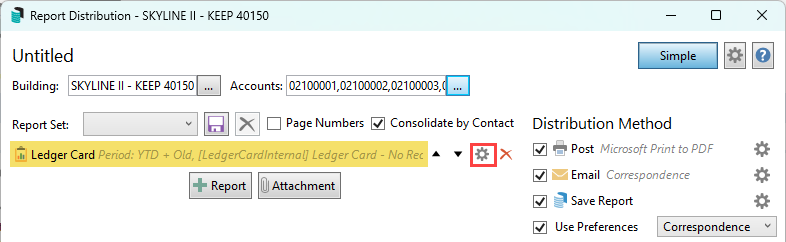
- Ledger Card & Ledger Card (Second Debtor): Year to date, Year to date - include old year, Month to Date, Selected Month, From Last Zero Balance, All History, Date Range.
- Recommended template: Ledger Card Internal Style. This produces the ledger card for multiple accounts, ready to distribute to a single recipient, and omits owners' or internal users' names.
- Lot Account Dissection: Default (Current Date), Current Year, Old Year, Current and Old Year.
- Arrears Issued: Current Date. This report includes the stage, date, lot, and unit number.
- Payment Plan Statement: Current Date. This report includes the start date of the payment plan, reporting as at today, and a summary of outstanding levy contributions and interest charged, with a table of payments received.
Financials
- Account Summary: Default (Current Year), Current Year, Old Year, Current and Old Year.
- BAS Reconciliation: Ending Last Quarter, Ending Last Month.
- Cash Flow Management Report: Current Date.
- Financial Statements: Current Year, Last Month, Old Year, Current and Old Year.
- Income Tax Report: Current Date.
- Key Financial Information (Statement of Key Financials - NSW): Current Date.
- Lot Balance: Default (Current Year), Current Year, Old Year, Current and Old Year.
- Receipt Summary: Current Date.
- Receipts Report: Override period start date and end date.
- Status Report: Override period start date and end date. Quarterly Reports can be configured.
- Transaction List: Current Year, Current Month, Old Year, Current and Old Year.